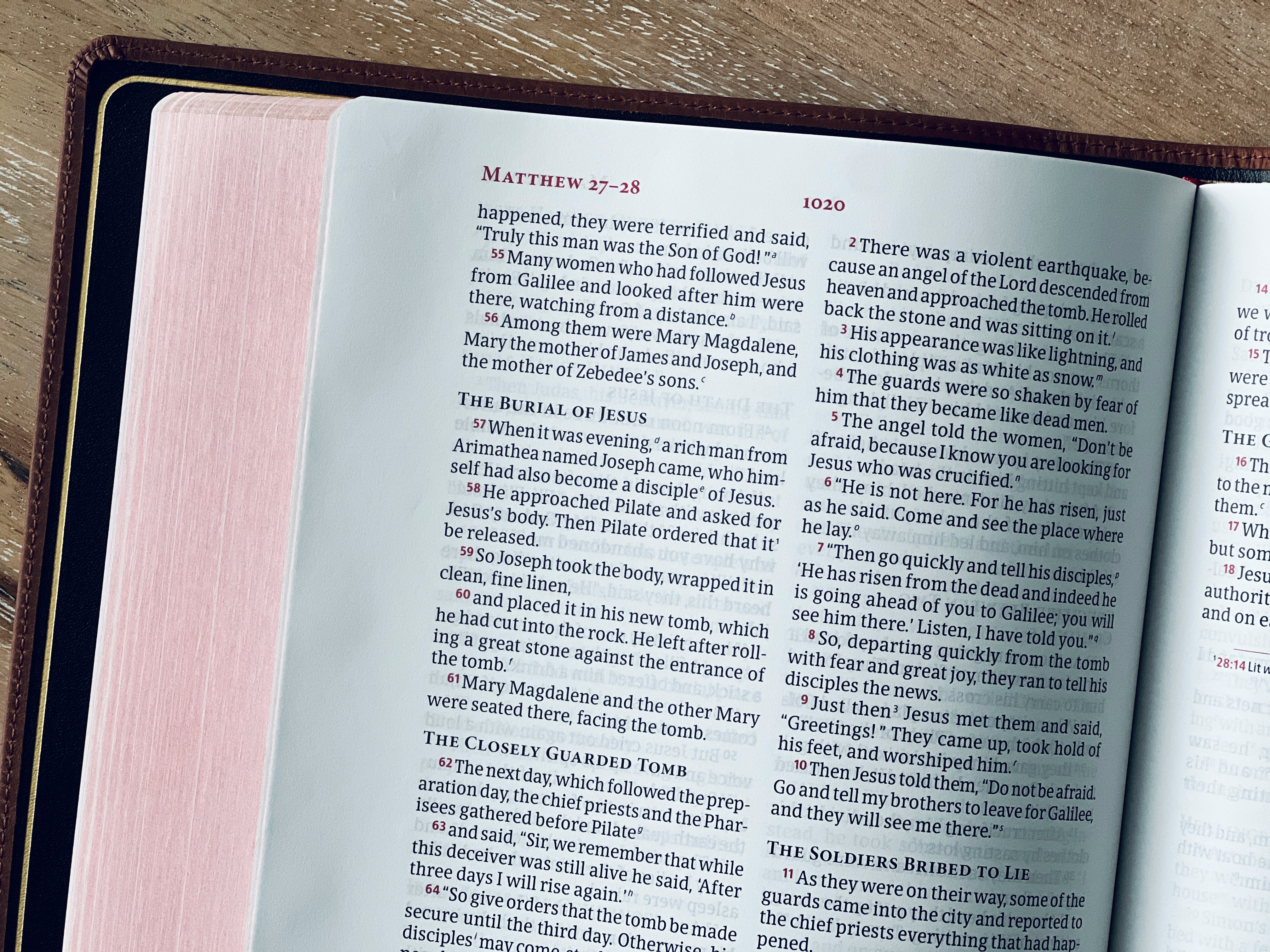
Matthean Priority
The New Testament begins with the four Gospels called Matthew, Mark, Luke and John. They are not biographies about Jesus (as many modern scholars falsely claim), but are selective written summaries highlighting the details of who Jesus is and explain why He came to earth. He is the eternal, uncreated Logos who took on full humanity to die as a substitute for repentant sinners in obedience to God the Father. Every incident, story, conversation, and character included in the four Gospels deliberately informs that great truth.
Notice I listed them above in the following order: Matthew, Mark, Luke and John. That is for two main reasons. The first is because that is their present order in all our English Bibles. The second reason for the order is because when the New Testament was formalized into one canon with all twenty-seven books, the Gospels were put first, and Matthew came before the other three. Matthew came before the other three because the early church believed, and knew, that Matthew wrote his Gospel before Mark, Luke and John. In fact, according to long-standing church tradition, Matthew wrote first in the 40s or 50s AD, followed a few years later by Mark, and then Luke, who wrote in the 60s, and John was the last Gospel written around 90 AD. So, the four Gospels in our current Bibles are placed in chronological order. In other words, for about 1,800 years, the consensus of the church was that Matthew wrote before the three other Gospel writers. Matthew wrote first!
An Unwelcome Change
Today that is no longer the case. Currently the majority report is that Mark wrote first, and Matthew wrote after Mark and even copied the majority of Mark’s Gospel. By “majority report” I mean the large percentage of so-called Bible scholars. In the name of “modern scholarship” 1,800 years of solid, reliable, consistent ancient church testimony and tradition has been categorically overturned…and not for good reason; actually for a lot of bad, invalid reasons.
The idea that Mark wrote first and that Matthew copied Mark arose for the first time in a popular way in the 1800s. This modern notion of Mark writing first came to be known in biblical studies as “Marcan priority.” This novel theory was artificially conceived by post-Enlightenment, liberal German theologians who specialized in the “new” Higher Criticism of the Bible.
By “Enlightenment” I mean the secular worldview that arose after the Reformation that prioritized human autonomy over religious tradition, the Church’s authority, and what the Bible says. Human intellect reigned supreme among secularized, Enlightenment thinkers. By “liberal” I mean religious scholars who wanted to be “liberated” from traditional constraints in thinking, like established doctrine, church dogma, and biblical authority. They wanted “liberty” and freedom in their thinking; they wanted to think their own way with no impediments from long-established clerical accountability. And by “Higher Criticism” I mean the destructive critical approach to studying the Bible that began with the likes of Baruch Spinoza (1632-1677) and others in his train and then flourished in Germany in the 18th and 19th centuries. The “scholarly” Higher Critics argued that the Bible was just like any other book, nothing special, as they downplayed its supernatural nature and eschewed its moral demands. So, the “Higher Critics” treated the Bible as strictly a humanly-generated book, lacking miracles and prone to error.
These critical scholars questioned everything that the church had established to be true about the Scriptures over thousands of years. They questioned the authorship of every book in the Bible. They questioned established dates of when the books were written, always pushing the dates way beyond what tradition or the facts had established. They questioned the unity and authenticity of individual books, claiming they were eclectic, literary conglomerates patched together in an evolutionary manner by disparate, unrelated parties. They subjected the Gospel of Matthew to these destructive and skeptical tactics, claiming the Gospel of Matthew wasn’t written by Matthew the Apostle, nor was it written in the 40s or 50s AD, and it certainly wasn’t a unified and harmonious literary work from the hand of one author.
Unwelcome Fruits
As a result, today even many “conservative” seminaries as well as countless mainstream Bible dictionaries, encyclopedias and Bible commentaries all perpetuate the misguided modern critical view of Matthew’s Gospel, having abandoned the long, time-honored, unified consensus of the church’s past 1,800-year testimony that Matthew the apostle wrote the book, and that he wrote it early, before Luke and Mark.
Take a few examples. The recent Eerdman’s Dictionary of the Bible assumes the modern, liberal Higher Critical view as it dogmatically asserts that Matthew “was composed during the last decades of the 1st century” and states “the majority of scholars hold to the priority of Mark and believe Matthew used Mark as a source.”1 The supposedly “conservative” Ligonier Reformation Study Bible compromises on Matthew as well, purporting in its study notes, “The writer of this gospel may have used the gospel of Mark.”2 Craig Blomberg, of the “Conservative” Baptist Denver Seminary, says Mark wrote first, Matthew copied Mark, and we cannot even be sure the Gospel of Matthew was written by an apostle!3 The oft-reliable D. A. Carson, unfortunately, trips up terribly in his commentary on Matthew, arguing in favor of the modern liberal assertions saying that “Matthew and Luke both depend on Mark” and that “we cannot be entirely certain who the author of the first Gospel is.”4 And sadly, the usually trustworthy Pastor Chuck Swindoll makes a misstep, as he leans toward the modern “scholarly” view that Mark wrote before Matthew, since Matthew copied Mark’s work.5
Staying True
All is not lost though. There are still a few good, conservative Bible teachers and resources towing the line, remaining courageous, and giving proper respect to established, informed church tradition regarding the authorship of Matthew’s Gospel (but admittedly, they are in the super-minority).
The Bible Knowledge Commentary by the Dallas Seminary faculty correctly says Matthew wrote before Mark around 50 AD.6 Lenski says plainly, “Matthew wrote before Mark and Luke and thus drew on neither of these two.”7 Pastor David Jeremiah is on target as he says in his study Bible that Matthew wrote first, around 50 AD, and Mark a little later.8 Geisler rightly affirmed the preferred traditional view as he wrote, “the early and ancient church said Matthew wrote before Mark, and they were in a better position to know, being closer to the sources…putting Mark first, as many contemporary critics do, is unnecessary literarily, questionable philosophically, and unjustified historically.”9 And the always-faithful pastor, John MacArthur, wrote convincingly in his study Bible that Matthew wrote first, early, and he did not copy Mark’s Gospel. Further, he notes, “The nearly unanimous testimony of the church until the nineteenth century was that Matthew was the first Gospel written. Such an impressive body of evidence cannot be ignored….The traditional view that the gospel writers were inspired by God and wrote independently of each other–except that all 3 were moved by the same Holy Spirit (2 Pet 1:20)–remains the only plausible view.”10
Going Off Track
So, how did we get to this point where the super-majority of evangelical scholars, teachers, commentators, and seminaries all hold tenaciously to Marcan priority? When did the conservative Christian community turn away from 1,800 years of reliable, unanimous consent? And why? Well, on one hand, that’s what sinful humanity always does–they compromise as time goes by (Lev 26:14-39; Deut 4:9, 23-28). They question God and His Word as the decades go by. Sometimes one generation fails to pass the baton of truth on to the next generation with meticulous diligence and stringent accountability. Moses faithfully gave Israel the Law of God, but as time passed, the generations that followed allowed compromise to set in. The apostles planted churches based on the true gospel in the regions of Asia Minor, and within a couple decades five of the seven key churches became compromised (Rev 1-3). The New Testament canon was complete by 95 AD and by the second century compromised ecclesiology became the norm in many churches.
As fallen people, we are prone to forgetting the faithful ones of the past as we forge ahead pursuing the new, the intriguing, the imaginative, the creative, the unexpected. The last thing we often want is the ancient and the conservative, those restricting “old hat” ideas that stifle our progress. We often want the “progressive” and pioneering notions. The newer and younger generation is prone to forget and dismiss the solid and safe foundations laid down by their predecessors (Deut 19:14; Prove 22:28). Like foolish King Rehoboam, the current generation often despises the wisdom of the elders and “the old guys” who came before them, thinking if it’s old then it must be stale, deficient, and irrelevant (cf. 1 Kings 12:1-17). As a result, they get off the tracks and lose their bearings.
On the other hand, this specific compromise on the proper view of Matthew’s authorship of his Gospel can be pinpointed to a very specific time in history and can be pinned on some very specific compromised “scholars.” If you were to ask AI, “Who was the first to propose that Mark wrote the first Gospel,” it might tell you there were a few men responsible, including Gottlob Christian Storr (1770-1831), Christian Gottlob Wilke (1786-1854), Christian Hermann Weisse (1801-1866), and Heinrich Julius Holtzman (1832-1910), among others. And in this case, AI would be correct. Against all tradition and precedent, in 1786 Storr, proposed the theory that Mark wrote before Matthew in his book, On the Purpose of the Evangelical History. He was not a full-blown anti-supernaturalist, but he definitely imbibed the spirit of the age in German scholarship and thus wielded the Higher Critical method when examining Scripture. He called his method a “scientific” approach. His proposal of Marcan priority was not initially well-received by the scholarly community. But it eventually took root in his followers, and consequently his view reigned supreme with an unshakeable hegemonic hold in New Testament studies. That is the case today. Currently if you believe, profess and teach that Matthew wrote before Mark, like I do, then you are considered ignorant and uneducated in the academic community.
In 1838, the liberal German theologian, Christian Gottlob Wilke, argued for Marcan priority in his book, The Original Evangelist. His disdain for the early church fathers and their views about apostolic tradition is evident in his writing, as his presuppositions betray his perspective. He dogmatically asserts that “the authors of the Gospels were not independent and autonomous writers” and concludes, “we can then correct the statements of the church writers, which we should regard with proper skepticism as historical accounts.”11 Contrary to Wilke’s assertions, the Gospel writers were independent authors, Matthew being a very eyewitness to the three-year ministry of Jesus, and they were led supernaturally by the Holy Spirit as they wrote their respective Gospels. They did not depend on human sources or solely their own recollections for their content, but rather they were guided along by God’s sovereign Spirit. The Apostle Peter reminds us of God’s divine methodology when He used His servants to write down His Scriptures:
For we [the authors of New Testament Scripture] did not follow contrived myths when we made known to you the power and coming of our Lord Jesus Christ; instead, we were eyewitnesses of his majesty….Above all, you know this: No prophecy of Scripture comes from the prophet’s own interpretation, because no prophecy ever came by the will of man; instead, men spoke from God as they were carried along by the Holy Spirit (2 Pet 1:16, 20-21).
This statement Peter gave about the men who wrote the Bible applies to Matthew, for He was personally recruited and employed by God to write a Gospel concerning Christ. Matthew wrote independently, being guided into all truth, describing exactly what happened historically, perfectly and without error (cf. John 14:16-17; 16:13). Wilke, Storr and the other critical German liberal theologians rejected the truth of 2 Peter 1, and viewed the Bible, and Matthew’s Gospel, as merely a human book, as they did not give proper place to the divine enablement of the Holy Spirit in their analysis of the Gospels.
Faithful Forebears
It is significant that prior to the late 17th century no one was arguing for Marcan priority. Those closest in age to the apostles affirmed unanimously that Matthew wrote the first Gospel and that he wrote early. This view was affirmed by a long train of faithful saints through the ages, including Papias (60-163), Irenaeus (130-202), Eusebius (260-340), Augustine (354-430), Gregory the Great (540-604), Aquinas (1225-1274), Calvin (1509-1564), Owen (1616-1683), Edwards (1703-1758), Hodge (1797-1878), and Berkhof (1873-1957), to name a few.
Sadly today, many Christians have a propensity to dismiss the views of those who were ancient or of those who came before us. This is a dangerous posture. Tradition is not infallible, but it is not to be flippantly dismissed in ignorance. C. S. Lewis is helpful here, for he testified that as a 20th-century scholar trained in the classics, and being a modern man, his default was to look down his nose at anything archaic or aged. For him, “the new was true.” Then he wised up, humbled himself and realized the danger on being a know-it-all, and began to appreciate the wisdom of those who have gone before us, especially the “great cloud of witnesses” who knew and loved God and His truth (Heb 12:1). As a result, Lewis popularized the phrase “chronological snobbery” which referred to those who think only moderns are smart and educated, while the old is cold with mold.
When I was in seminary at The Master’s Seminary, I had several professors, who were world-class Bible scholars, that repeatedly warned us students with the adage, “If it’s new, it’s not true,” when it comes to theology and Bible doctrine. That has served me well since I was first brainwashed with it in 1989. Pastor John MacArthur told me a similar truth when I was a new believer in college, and it had an indelible impact on me ever since. He said, “Cliff, we don’t need pioneers in biblical studies! We need propagators. God’s truth has been given fully, once and for all in His Word–the faith delivered once and for all, to the saints” (cf. Jude 3). I thank God for faithful saints through the ages, and even more recently mentors who warned me how to stay on the straight and narrow in my own life. We need God’s help to stay true to the faith moving forward, even when it means we may be in the minority and subject to ridicule. In such cases, trust God and count it all a blessing.
NOTES
1David Freedman, ed. (Grand Rapids, MI: Eerdmans Publishing, 2000), 871.
2R. C. Sproul, ed. (Sanford, FL: RT Publishing, 2017), 1431.
3Craig Blomberg, The New American Commentary: Matthew (Nashville, TN: Broadman Press, 1992), 37, 43.
4The Expositor’s Bible Commentary, Vol. 8, ed. Frank Gaebelein (Grand Rapids, MI: Zondervan, 1984), 13, 19.
5The Swindoll Study Bible (Carol Stream, IL: Tyndale House, 2017), 1136.
6The Bible Knowledge Commentary: NT, ed. John Walvoord (Wheaton, IL: Victor Books, 1983), 16.
7R. C. H. Lenski, The Interpretation of Matthew’s Gospel (Minneapolis, MN: Augsburg Publishing, 1964), 19.
8The Jeremiah Study Bible (Worthy Publishing, 2013), 1282, 1339.
9Norman Geisler, A Popular Survey of the New Testament (Grand Rapids, MI: Baker Books, 2007), 50.
10The MacArthur Study Bible: NKJV (Nashville, TN: Word Publishing, 1997), 1453-1454.
11Christian Gottlob Wilke, The Original Evangelist, trans. by Neil Godfrey (Dresden and Leipzig: Gerhard Fleisher, 1838), 19.